A CV format (Curriculum Vitae format) is the structural organization used to arrange your professional achievements, educational degrees, technical competencies, projects, certifications, and research publications on a page.
While visual template design controls fonts, margins, and colors, the CV format dictates the logical sequence of information—ensuring that recruiters and Applicant Tracking Systems (ATS) discover your strongest qualifications immediately.
Looking for related resume frameworks or ATS parsing rules? Explore our guides on What Is a Resume?, How to Make a Resume, Resume Format Guide, Resume for Freshers, Resume for Experienced Professionals, and ATS-Friendly Resume Guide.
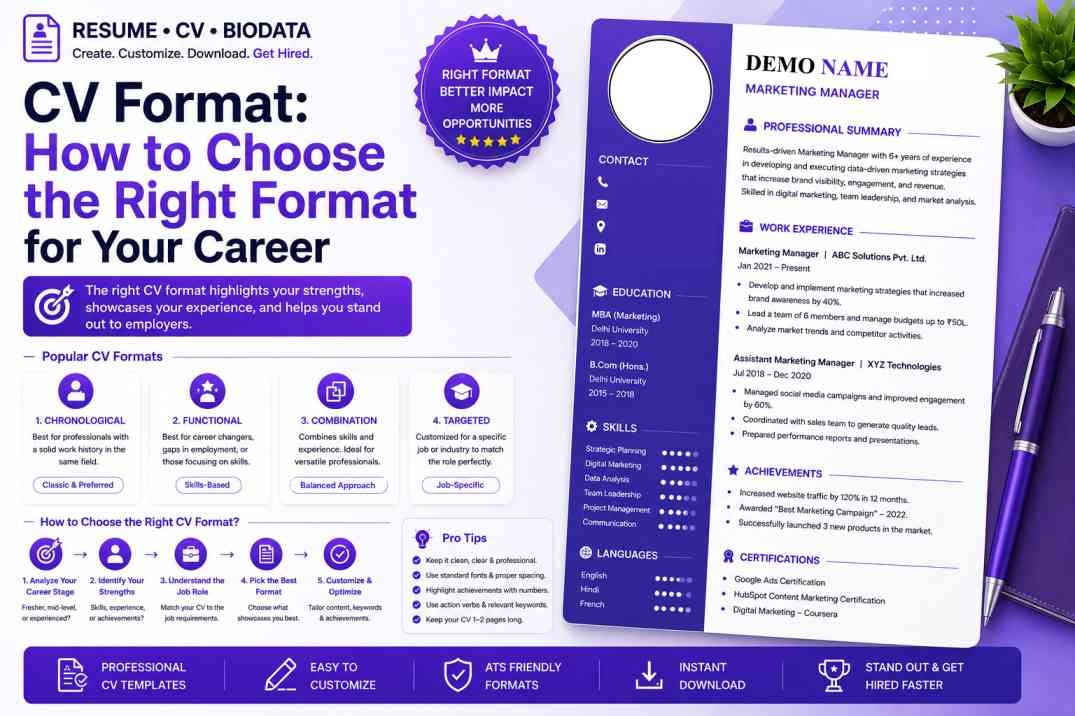
Lists employment history in reverse order, starting with your most recent position. Highly favored by recruiters and ATS software because it clearly proves steady career growth.
Best Suited For: Experienced candidates, professionals with a consistent work history, and applicants seeking roles within the same industry.
Groups qualifications into functional skill clusters (e.g., Project Management, Client Communication) rather than detailing a strict chronological timeline.
Best Suited For: Candidates returning to work after career gaps, career changers emphasizing transferable skills, and individuals with non-linear employment history.
Blends prominent technical and specialized skill blocks at the top of the page with a reverse-chronological work history underneath.
Best Suited For: Senior specialists, technical leads, project managers, and experienced professionals changing target sub-sectors.
| CV Format | Primary Focus | Career Stage Suitability | ATS Readability |
|---|---|---|---|
| Chronological | Recent Employment & Progression | Experienced Pros, Consistent Careers | High (Standard) |
| Functional | Skill Clusters & Capabilities | Career Gaps, Major Career Pivots | Moderate / Caution |
| Combination | Specialized Skills + Work History | Senior Leads, Technical Specialists | High |
Position Education → Key Skills → Academic Projects → Internships → Certifications above formal work history to emphasize knowledge and hands-on coursework potential.
Use a Reverse-Chronological structure to feature recent leadership, verified project outcomes, and promotions from the last 5–10 years.
Utilize a Combination structure. Highlight transferable skill groups (e.g., Data Analysis, Project Coordination) near the top before listing previous job history.
An Academic CV differs significantly from corporate job-search CVs. It is an exhaustive multi-page document used for university faculty, scientific research, grants, and fellowship applications.
Single-Column Layouts: Highly recommended for online applications submitted through Applicant Tracking Systems (ATS). They ensure sequential text extraction without column merging errors.
Two-Column Layouts: Visually appealing for direct email submissions, networking events, or creative portfolios. However, complex split tables can confuse older ATS parser algorithms.
YOUR FULL NAME
Professional Job Title
Phone | Email | Location | LinkedIn / Portfolio

PROFESSIONAL SUMMARY
Concise 3-4 line summary of professional experience, core domain, and value.

CORE SKILLS
• Skill 1  • Skill 2  • Skill 3  • Skill 4  • Skill 5

PROFESSIONAL EXPERIENCE
Job Title — Company Name | Location (Dates)
• Key contribution or quantifiable achievement
• Responsibility using specific tool or process

EDUCATION
Degree Name — Institution Name (Year)

CERTIFICATIONS & PROJECTS
• Certification Name — Issuing Body (Year)
• Project Deliverable Summary
Verify these items before finalizing your document layout:
There is no single best format. A reverse-chronological CV format works best for candidates with steady employment, while a combination or functional CV suits freshers, students, and career changers.
An academic CV is a comprehensive, multi-page document detailing research history, publications, teaching experience, grants, and scholarly honors, whereas a corporate CV is a 1-3 page document focused on job-relevant skills and accomplishments.
A two-column CV layout looks modern and visually balanced, but if applying through an online portal that uses Applicant Tracking Systems (ATS), a single-column layout is safer for accurate parsing.
A corporate CV generally spans 1 to 2 pages (or 3 pages for senior roles), whereas academic or research CVs can extend to 5+ pages depending on publications and research history.
Select an ATS-conscious template and start building your document online with live preview.